Curly Leaf Pondweed
Invasive Species | Aquatic Plants

Curly Leaf Pondweed
(Potamogeton crispus)
Curly Leaf Pondweed (Potamogeton crispus) is an aquatic plant native to Eurasia, Africa, and Australia. It was introduced to North America in the late 1800s, likely through the aquarium trade or unintentionally during carp stocking efforts. In New Brunswick, Curly Leaf Pondweed is found in a few isolated locations but continues to expand its range. It grows fast, spreads quickly, and outcompetes native plants, creating serious problems for both nature and people. Because of its aggressive growth and impact on ecosystems, Curly Leaf Pondweed is considered a major threat to freshwater environments.
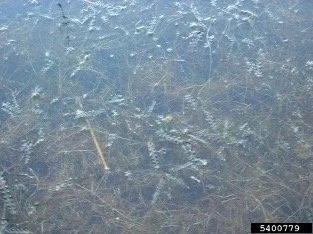
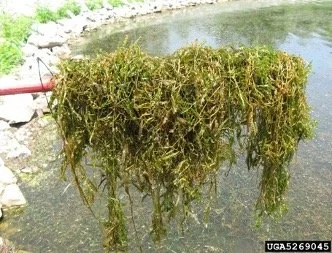
(Photo credit: Graves Lovell, Alabama Department of Conservation and Natural Resources, Bugwood.org )

Problem:
Curly Leaf Pondweed is a species that is easily established, and it begins its growth cycle earlier in the season compared to our native aquatic plants. It reproduces through seeds and vegetative buds called turions, which can overwinter under ice and sprout in early spring. The plant naturally dies back soon after turion formation, and the turions remain dormant in the sediment during the remainder of the summer and early fall. It is a species with both sexual and asexual reproductive capacities in freshwater ecosystems. The plant forms dense mats that can outcompete native vegetation and impede recreational activities such as boating, swimming, and angling and disrupt water flow in the affected areas.
Species identification:
You can spot Curly Leaf Pondweed by looking for these key features:
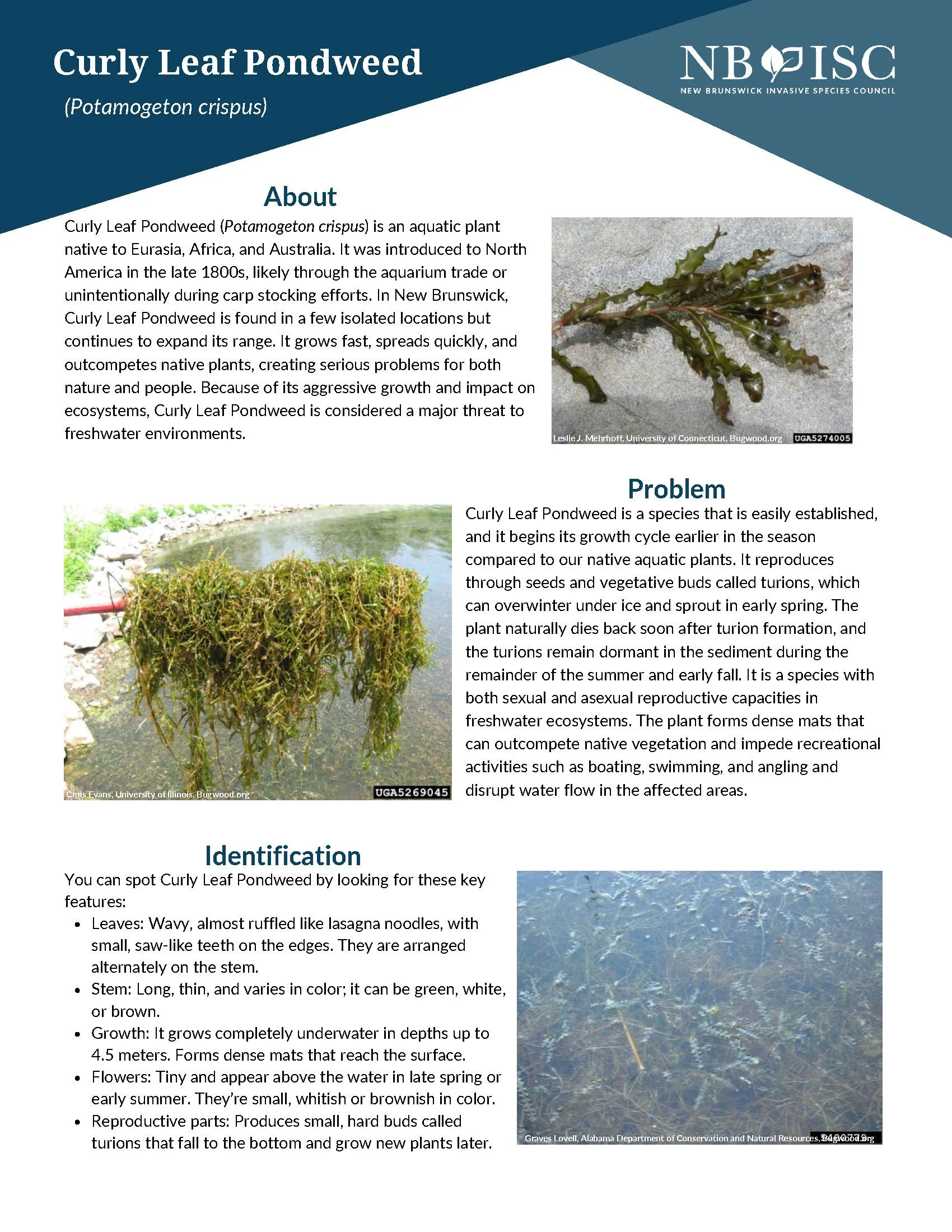
Leaves: Wavy, almost ruffled like lasagna noodles, with small, saw-like teeth on the edges. They are arranged alternately on the stem.
Stem: Long, thin, and varies in color; it can be green, white, or brown.
Growth: It grows completely underwater in depths up to
4.5 meters. Forms dense mats that reach the surface.
Flowers: Tiny and appear above the water in late spring or early summer. They’re small, whitish or brownish in color.
Reproductive parts: Produces small, hard buds called turions that fall to the bottom and grow new plants later.
Prevention:
Curly Leaf Pondweed is spread naturally and by human activity. Fragments of the plant can drift, settle, and regrow, allowing it to disperse easily. But, human activities can also contribute to the spread of the species, through aquatic hitchhiking on commercial or recreational boats, ballast water, and through the use of fouled fishing gear in non-invaded areas. The best way to stop the spread is to follow CLEAN DRAIN DRY practices when travelling between different waterbodies. It is extra important to be vigilant when travelling through areas with known populations of Curly Leaf Pondweed, to ensure that you are not moving aquatic hitchhikers from one waterbody to another.
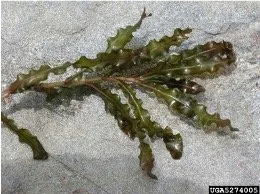
Leslie J. Mehrhoff, University of Connecticut, Bugwood.org
Chris Evans, University of Illinois, Bugwood.org
Leslie J. Mehrhoff, University of Connecticut, Bugwood.org